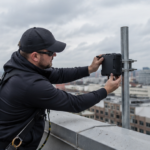
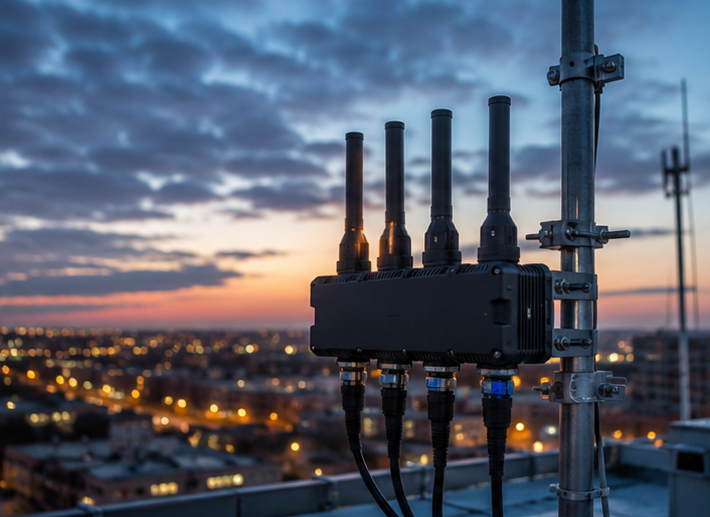
Most security teams think about detection in terms of what they put out: cameras, floodlights, active radar, radio transmitters. Passive sensing flips that. Instead of broadcasting, passive sensors listen. Instead of illuminating, they observe what’s already there.
That distinction matters more than it might seem. A passive sensor has no emissions to detect, no active footprint to jam, and no RF signature to give away its presence. It works around the clock, in the dark, in the rain, without announcing itself. For facility operators, public safety teams, and anyone monitoring airspace around a sensitive site, that’s a significant operational advantage.
WHAT PASSIVE SENSORS ACTUALLY DO
Passive sensors detect signals and signatures that already exist in the environment. A drone operating nearby is broadcasting: its Remote ID, its control link, its video downlink, its acoustic signature from spinning rotors. A passive sensor doesn’t need to ping the drone or interrogate it. It just needs to listen.
The major categories are:
Remote ID (RID) reception. Under FAA rules that took full effect in 2023, most commercial and recreational drones in the US are required to broadcast identification and location over Bluetooth or Wi-Fi. A passive RID receiver decodes that broadcast and logs the drone ID, position, altitude, and the operator’s takeoff location. No active interrogation required.
Passive RF sensing. Beyond RID, drones emit control link signals, video downlinks, and telemetry. Common open-source autopilot platforms transmit MAVLink protocol on well-documented frequencies. DJI systems use OcuSync, a proprietary but recognizable signal. An RF sensor that can identify these emissions gives you a detection layer that works even when a drone isn’t broadcasting compliant RID.
Acoustic sensing. Every propeller-driven aircraft produces a characteristic rotor signature. Acoustic sensors use microphone arrays and machine learning classifiers to distinguish drone noise from wind, traffic, and HVAC. Range is typically 100 to 300 meters for small drones, but acoustic sensing is entirely passive and requires no RF emissions whatsoever.
ADS-B detection. Manned aircraft transmit position, altitude, and identification over ADS-B. A passive receiver covers this traffic without any licensing requirement and can provide awareness over 100 nautical miles under good conditions. For sites near airports or flight corridors, knowing the difference between a compliant manned aircraft and an unknown drone is operationally significant.
WHY NO SINGLE SENSOR IS ENOUGH
RID only covers compliant drones. Modified platforms, foreign-manufactured drones, and deliberately non-compliant systems may not broadcast. RF sensing helps close that gap, but signal conditions vary. Acoustic sensing is range-limited and affected by local noise.
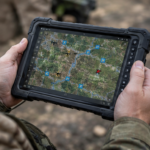
The real value comes from layering. An acoustic alert plus an RF change plus a camera cue is far more actionable than any one of those signals alone. A well-designed passive sensing deployment produces confidence-scored events, not just binary alarms, so operators know whether something warrants investigation or just a log entry.
That fusion requires more than stacking sensors. It requires thinking clearly about the operational question first: what are you trying to detect, over what area, with what response available, and what false alarm rate is acceptable? Answering those questions before buying hardware is the most important step most organizations skip.