Detecting a drone near your facility is useful. Knowing where it is, sharing that information with everyone who needs to respond, and coordinating that response without radio calls or verbal relay is operationally valuable. That gap between detection and coordinated response is where TAK comes in.
WHAT TAK IS
The Team Awareness Kit (TAK) is an open-source common operating picture platform originally developed for US military use and now widely adopted by law enforcement, fire and rescue, emergency management, and civilian security teams. It runs on Android (ATAK), iOS (iTAK), and Windows (WinTAK).
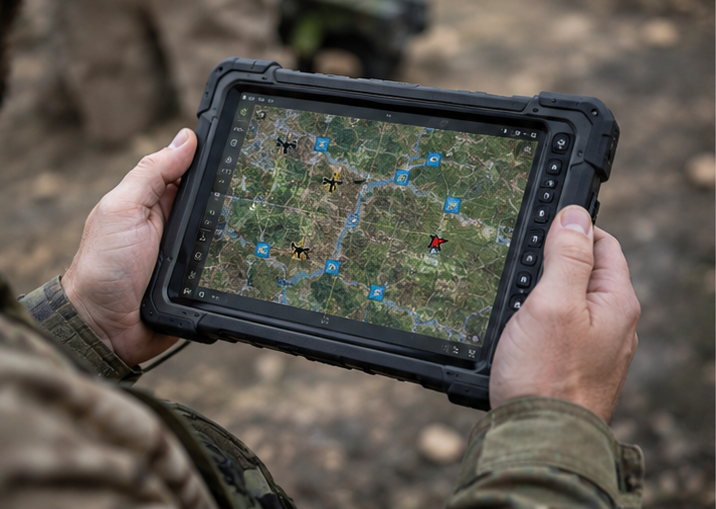
A common operating picture is exactly what the name says: one shared map display where all relevant data appears simultaneously for every member of the team. A patrol officer in the field, a dispatcher at a desk, and a supervisor in a vehicle all see the same picture at the same time. Sensor alerts, GPS tracks, video feeds, and team member locations all appear in the same interface.
TAK is free. The core platform and most plugins are open source. That’s a meaningful distinction in a market where proprietary sensor management software often costs as much as the sensors themselves.
HOW PASSIVE SENSORS FEED INTO TAK
TAK ingests data using a standard format called Cursor on Target (CoT). Most passive sensing vendors now support CoT output, which means their detections can flow into a TAK environment with minimal custom integration work.
In practice, that looks like this: a passive RF sensor detects an unknown emission consistent with a DJI control link. That detection appears as a georeferenced icon on the TAK map. If an acoustic sensor at a second location corroborates the contact, the icon updates. The resource nearest the location can see it on their device. No radio relay needed. No one working from a different picture.
Fusing multiple sensor types through TAK produces something more useful than any individual alert: a confidence-scored track with enough context for an operator to make a decision. Is this a compliant drone that just failed to register? A modified platform operating without RID? A known vendor performing authorized work? TAK doesn’t answer that automatically, but it gives the operator the information to answer it themselves, quickly, with the whole team sharing the same picture.
WHAT TAK DOES WELL AND WHERE IT REQUIRES WORK
TAK’s plugin ecosystem is large and uneven. There are strong plugins for sensor management, video display, personnel tracking, and messaging. There are also plugins that are poorly maintained, have limited documentation, or don’t perform reliably across all TAK versions.
Selecting the right combination of plugins for a specific use case requires someone who knows which integrations actually work in the field. This is one area where having an experienced advisor involved before committing to a TAK-based deployment makes a real difference.
Cellular backhaul is also worth addressing separately. TAK works over both local mesh radio networks and internet-connected cellular infrastructure. For distributed deployments, campuses, and public safety agencies coordinating across multiple sites, cellular backhaul allows the common operating picture to function across geographic distance. Passive sensors with cellular backhaul capability can report into a shared TAK environment from remote locations without requiring a direct radio link.
WHAT TO EXPECT FROM A WELL-INTEGRATED DEPLOYMENT
A well-integrated passive sensing and TAK deployment produces something specific: the right information, reaching the right people, at the right time, in a format they can act on.
That means confidence-scored alerts rather than binary alarms. It means a shared map that updates in real time without requiring radio calls to relay coordinates. It means the operator in the field and the supervisor at the desk are looking at the same picture when a decision has to be made.
Getting there requires clear definition of the operational problem, an honest pilot to validate sensor performance, and integration work that connects the sensor outputs to the TAK environment in a way that fits the operator’s actual workflow. None of those steps are especially complicated, but all of them require doing in order.
The technology is ready. The platform is free. The integration path is well-established. What it takes is someone who knows how to put it together for your specific environment.